Parental alienation occurs when one parent systematically undermines a child's relationship with the other parent through psychological manipulation — including badmouthing, loyalty tests, and reality distortion — resulting in the child's unjustified rejection of the targeted parent (Bernet & Greenhill, 2022). The child experiences loyalty conflicts, identity disruption, and long-term psychological harm that can persist into adulthood.
By Malcolm Smith · Last updated April 2026 · Based on peer-reviewed research
Of all the cruelties of parental alienation, what happens to the child is the greatest. They did not ask for this. They do not understand it. And yet they are the ones who carry it longest — because the consequences of being alienated from a parent do not end when the legal proceedings stop. They echo through decades.
When your child says "I don't want to see you," or "I hate you," or simply goes silent — the pain is so acute that it can be almost impossible to see past your own grief to what is actually happening in their internal world. But this is exactly what you need to do. Because when you understand what alienation does to a child psychologically, two things change: you stop taking it personally, and you start responding in ways that actually help.
This is not about excusing your child's behaviour. It is about understanding that the behaviour you see is a symptom — not a choice.
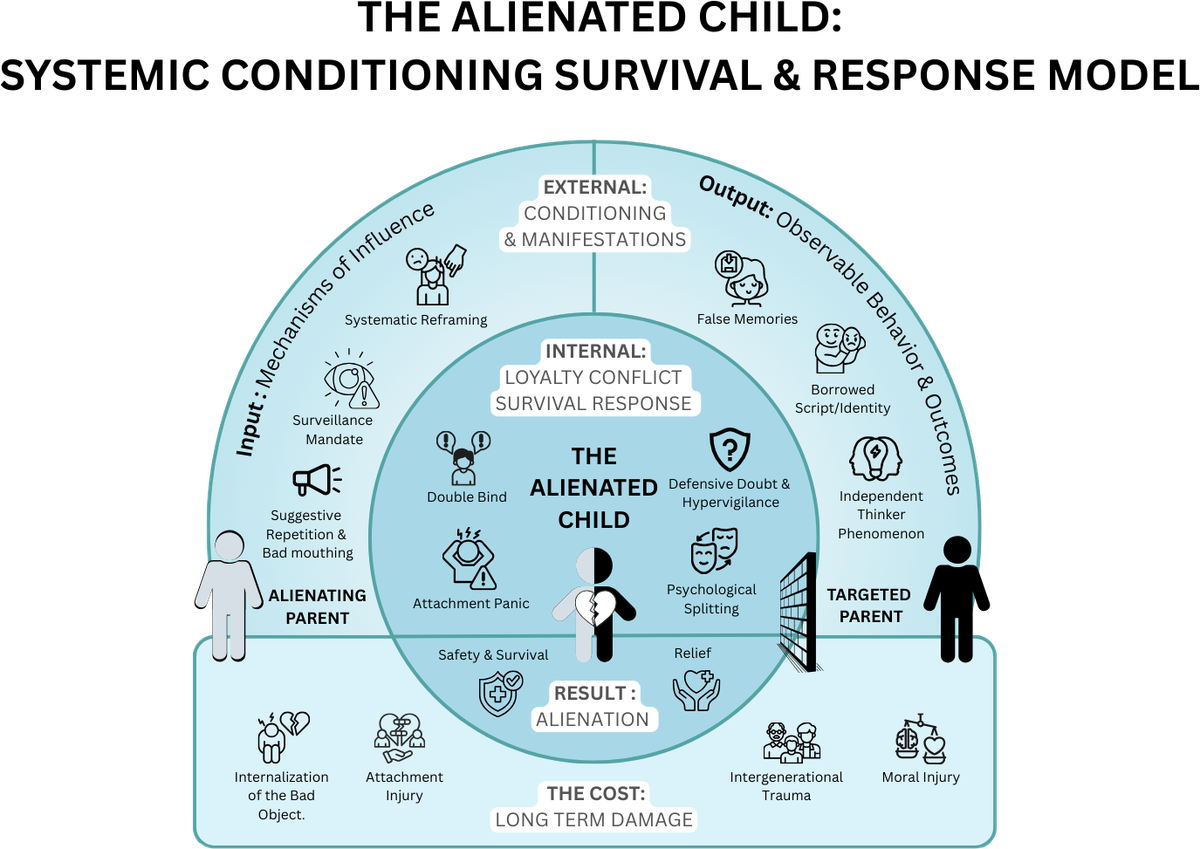
How does parental alienation affect a child?
To truly understand what is happening to your child, we must move beyond the surface-level rejection and look at the internal mechanics that drive it. The model above maps the invisible process that transforms a loving child into a hostile stranger.
We often make the mistake of thinking the child's behaviour is a choice. Research on attachment theory (Bowlby, 1969) reveals that it is actually a reaction — a desperate biological response to an impossible environment. It unfolds in four phases.
The Input — Mechanisms of Influence
On the left side of the model, we see the external forces acting upon the child. The alienating parent does not always need to scream or threaten. Often, the control is exerted through three subtle but devastating mechanisms, consistent with Baker's (2007)identification of 17 alienating strategies:
Systematic Reframing
Past memories are twisted and rewritten. Happy moments with you are recast as dangerous, selfish, or fake. The child's own history is slowly replaced with a version that supports the alienating narrative.
Suggestive Repetition
Lies repeated often enough begin to feel like truth. Research byCeci and Bruck (1995)demonstrated that children exposed to suggestive questioning developed vivid memories of events that never occurred. The child hears the same negative messages so frequently that the fabrication hardens into belief.
The Surveillance Mandate
The child learns they are being watched, or that they must report back to the alienating parent after every visit. This creates a state of hyper-vigilance where they can never truly relax in your presence. Every moment with you is monitored — even when no one else is in the room.
The Internal Crisis — The Survival Response
These inputs trigger a catastrophic internal crisis. In the centre of the model, we see the child trapped in a Double Bind — a psychological no-win scenario where loving you is dangerous, but rejecting you is painful. This mechanism is grounded inBowlby's attachment theory (1969): children are biologically wired to maintain proximity to their primary caregiver, even at enormous psychological cost.
Attachment Panic
The child's brain senses a threat to their primary bond with the alienating parent — their "survival" figure. Biology takes over. The attachment system fires, demanding the child prioritise safety above all else.
Defensive Doubt
A pervasive uncertainty takes hold. The child begins to question their own memories, their own feelings, and their own experience of you. What was once clear becomes murky. What was once loved becomes suspect.
Psychological Splitting
To resolve the unbearable tension, the child engages in splitting — a defence mechanism identified byKernberg (1975)— viewing you as "all bad" to justify the rejection. Black-and-white thinking replaces nuance. You become the villain in a story they did not write but now fully believe.
The child does not reject you because they hate you. They reject you to stabilise their own world.
The Output — The Mask of Rejection
What you see on the outside — the observable behaviours on the right of the model — are simply the defences the child constructs to survive that internal panic. They are not showing you who they are. They are showing you who they have had to become. These behaviours align withGardner's (1998) eight behavioural manifestationsof parental alienation:
Borrowed Scripts
The child repeats adult language that does not belong to them — phrases too sophisticated, too legal, too specific to have originated in a child's mind. They are echoing words placed there by someone else.
False Memories
As the negativity becomes fully integrated, the child can develop memories of events that never happened — a phenomenon extensively documented by Ceci and Bruck (1995). These feel completely real to them. A child can be 100% convincing and 100% wrong.
The "Independent Thinker"
The final stage: the child insists the rejection is entirely their own idea. "Nobody told me to feel this way." This apparent independence is actually the final stage of conditioning — and the most convincing mask of all (Gardner, 1998).
The "relief" the child feels when you are gone is not the relief of escaping an abuser. It is the relief of the anxiety stopping.
The Consequence — The Long-Term Cost
The short-term safety the child achieves through rejection comes at a devastating price. Parental alienation is classified as anAdverse Childhood Experience (ACE), andVerhaar, Matthewson & Bentley's (2022) qualitative study of 20 adults alienated in childhoodfound that 100% of participants reported lasting mental health consequences. The base of the model shows the long-term damage that accumulates beneath the surface — often invisible for years, but always there.
Attachment Injury
The child's capacity to form secure bonds is fundamentally damaged. If the person who loved them most could be erased, no relationship feels truly safe. This predicts difficulty in adult intimate relationships (Bowlby, 1969).
Moral Injury
Deep in the psyche, a wound forms from the guilt of having rejected a parent who loved them. Baker (2007)found that many adult children describe intense shame and guilt when they realise what they participated in. This guilt may be suppressed for years, but it does not disappear.
Internalisation of the "Bad Object"
The child begins to believe that if they came from a "bad" parent, they must be "bad" too. Identity fractures. Self-worth erodes from the inside. This pattern is associated with depression and vulnerability to manipulation in adult relationships.
They survive the childhood war. But they carry the wounds of that survival for a lifetime.
The research: parental alienation effects by the numbers
The effects of parental alienation on children are not anecdotal — they are documented across decades of peer-reviewed research.
What is the difference between parental alienation and estrangement?
Not every child who rejects a parent has been alienated. The critical clinical distinction — established by theFive-Factor Model (Bernet & Greenhill, 2022)— is whether the rejection is proportionate to the targeted parent's actual behaviour.
| Factor | Alienation | Estrangement |
|---|---|---|
| Prior relationship | Previously positive and loving | History of conflict or harm |
| Cause of rejection | Driven by the alienating parent's influence | Proportionate response to the rejected parent's behaviour |
| Ambivalence | None — targeted parent is "all bad" | Mixed feelings — child holds both anger and love |
| Reasons given | Weak, frivolous, or borrowed from an adult | Specific, credible, based on real experiences |
| Extended family | Rejection spreads to grandparents, cousins, etc. | Rejection is limited to the specific parent |
| Guilt | Absent — cruelty is treated as justified | Present — child feels conflicted about the distance |
| Independent thinking | Child insists "no one influenced me" | Child can explain their reasons without coaching |
Source: Gardner (1998), Bernet & Greenhill (2022), Drozd & Olesen (2004). SeeRecognising Alienation for the full diagnostic framework.
Why is alienation a solution, not a malfunction?
This is the hardest truth to accept: for the child, total rejection of youworks. By choosing one side, the war inside their head finally stops. They achieve two things simultaneously:
Safety
They neutralise the threat posed by the alienating parent, whose love is conditional on total loyalty. By rejecting you, they secure their position in the only home they have.
Relief
They escape the crushing tension of the loyalty bind. The impossible choice is no longer impossible — because they have made it. The anxiety stops. The internal conflict quiets.
The "relief" they feel is not the joy of independence. It is the relief of a hostage who has finally stopped resisting the captor.
Alienation's starkest tragedy
A child wired by nature to love both parents is slowly forged into the instrument that severs one bond — potentially forever. The targeted parent does not just grieve the loss. They watch helplessly as their own child is weaponised against them in a war neither chose.
"In my own story, I felt this viscerally: moments when my children's scripted anger pierced me — not from their hearts, but from a playbook they never authored."
Explore each dimension in depth
Each aspect of what alienation does to a child is explored across eight dedicated pages — from what your child is experiencing right now, to the damage it causes, to the hope that exists for the future.
The Loyalty Conflict
The impossible position
Your child has been placed in a position where loving you feels dangerous. The double bind, the biological hardwiring of attachment, and why your child "chooses" the alienating parent — not out of preference, but out of survival.
Read more →The False Self
The survival mask
The child who tells you they hate you is not showing you who they are. They are showing you who they have had to become. The false self, the "independent thinker" phenomenon, borrowed scripts, and black-and-white thinking.
Read more →Recognising Alienation
Signs versus normal resistance
How to distinguish alienation from normal developmental resistance. The Five-Factor Model, Gardner's eight behavioural manifestations, the severity spectrum, and the critical distinction between alienation and estrangement.
Read more →Memory and Suggestibility
How false memories form
A child can be 100% convincing and 100% wrong. The science of how children come to "remember" things that never happened — the Sam Stone study, the mousetrap experiment, and why confidence is not proof of accuracy.
Read more →The Damage Done
The long-term toll
Alienation is an Adverse Childhood Experience. It reshapes the nervous system, fractures identity, and leaves lasting psychological wounds — depression, attachment injury, moral injury, and vulnerability to manipulation.
Read more →What Your Child Loses
Beyond the parent-child bond
Your child does not just lose you. They lose grandparents, siblings, community ties, cultural identity — and the person they might have been. The intergenerational cycle of alienation and the family rupture it creates.
Read more →When Adult Children Wake Up
The Sleeper Effect
Many alienated children eventually see through the programme. Baker's research on what triggers the thaw, reconciliation realities, and why your patience and integrity today are the evidence they will use tomorrow.
Read more →"Your child is not your enemy. They are the other victim of the same process that is destroying you. Fight for them — not against them."
Frequently asked questions
Does an alienated child really hate their parent?
No. The rejection is a survival strategy, not a genuine feeling. The child is resolving an impossible loyalty conflict by siding with the parent whose love feels conditional on total loyalty. Baker's research (2007) shows that many alienated children later describe the rejection period as something that "happened to them" rather than something they chose.
What are the long-term effects of parental alienation on children?
Parental alienation is an Adverse Childhood Experience (ACE). Long-term effects include attachment injury, moral injury, identity fracture, depression, anxiety, substance abuse, and difficulty trusting intimate partners. Verhaar, Matthewson & Bentley (2022) found that 100% of their 20 adult participants alienated in childhood reported lasting mental health consequences.
Can an alienated child recover?
Yes. Baker (2007) found that many alienated children eventually see through the programme — triggered by life events such as the alienating parent turning on them, independent fact-checking, or their own experience of parenthood. The targeted parent's consistent, non-retaliatory behaviour during alienation becomes the evidence the child uses to reassess. See When Adult Children Wake Up.
Is parental alienation a form of child abuse?
Leading researchers including Bernet et al. (2010) and Warshak (2015) classify parental alienation as psychological child abuse. It meets criteria for emotional maltreatment: distorting the child's reality, forcing suppression of genuine feelings, damaging attachment systems, and causing lasting psychological harm.Kruk (2018) makes the fullest case for treating severe alienation as emotional abuse, and Spinazzola et al. (2014) found psychological maltreatment can be as damaging as physical or sexual abuse. Several jurisdictions now recognise it as such in family law.
How does parental alienation affect a child's memory?
Children are highly susceptible to memory distortion. Ceci and Bruck (1995) demonstrated that children can develop vivid "memories" of events that never occurred. In alienation, the alienating parent reframes past experiences until genuine memories are overwritten. See Memory and Suggestibility for the full science.
What is the difference between alienation and estrangement?
In alienation, the rejection is driven by the alienating parent — not by the targeted parent's actions. There was a previously positive relationship, the rejection is disproportionate, and the child shows Gardner's indicators (campaign of denigration, borrowed scenarios, lack of ambivalence). In estrangement, the rejection is a proportionate response to genuine harm. See the comparison table above.
How many children are affected by parental alienation?
An estimated 22 million parents in the United States are targeted by parental alienating behaviours (Harman, Leder-Elder & Biringen, 2019). In high-conflict separations, 11–15% of children show significant alienation (Fidler & Bala, 2010). Approximately 1 in 5 divorcing families experience significant alienating behaviours.
References
- Baker, A. J. L. (2007). Adult Children of Parental Alienation Syndrome: Breaking the Ties That Bind. W.W. Norton. amyjlbaker.com
- Bentley, C., & Matthewson, M. (2020). The not-forgotten child: Alienated adult children's experience of parental alienation. The American Journal of Family Therapy, 48(5), 509–529. DOI: 10.1080/01926187.2020.1775531 · Qualitative interview study (n=10).
- Verhaar, S., Matthewson, M. L., & Bentley, C. (2022). The impact of parental alienating behaviours on the mental health of adults alienated in childhood. Children, 9(4), 475. DOI: 10.3390/children9040475 · PMC · Plain-language summary · Thematic analysis of 20 adults alienated in childhood; source for the 100% mental-health-impact and 50% intergenerational-transmission findings.
- Bernet, W., Gregory, N., Rohner, R. P., & Reay, K. M. (2020). Measuring the difference between parental alienation and parental estrangement: The PARQ-Gap. Journal of Forensic Sciences, 65(4), 1225–1234. doi:10.1111/1556-4029.14300 · Measurement instrument supporting the Five-Factor Model.
- Bernet, W., & Greenhill, L. L. (2022). The Five-Factor Model for the diagnosis of parental alienation. Journal of the American Academy of Child & Adolescent Psychiatry, 61(5), 591–594. DOI: 10.1016/j.jaac.2021.11.026 · PMID 34929321 · Summary · Current diagnostic gold standard.
- Bowlby, J. (1969). Attachment and Loss, Volume 1: Attachment. Basic Books.
- Ceci, S. J., & Bruck, M. (1995). Jeopardy in the Courtroom: A Scientific Analysis of Children's Testimony. American Psychological Association. APA PsycNet
- Drozd, L. M., & Olesen, N. W. (2004). Is it abuse, alienation, or estrangement? A decision tree. Journal of Child Custody, 1(3), 65–106.
- Fidler, B. J., & Bala, N. (2010). Children resisting post-separation contact with a parent: Concepts, controversies, and conundrums. Family Court Review, 48(1), 10–47. DOI: 10.1111/j.1744-1617.2009.01287.x
- Gardner, R. A. (1998). The Parental Alienation Syndrome: A Guide for Mental Health and Legal Professionals (2nd ed.). Creative Therapeutics.
- Harman, J. J., Kruk, E., & Hines, D. A. (2018). Parental alienating behaviors: An unacknowledged form of family violence. Psychological Bulletin, 144(12), 1275–1299. PubMed
- Kernberg, O. F. (1975). Borderline Conditions and Pathological Narcissism. Jason Aronson.
- Warshak, R. A. (2015). Ten parental alienation fallacies that compromise decisions in court and in therapy. Professional Psychology: Research and Practice, 46(4), 235–249.