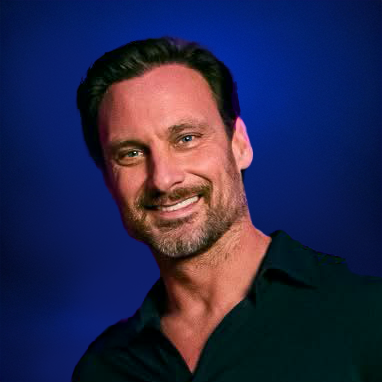
The author
Malcolm Smith
Father. Alienated parent. Author.
"You can take everything from me.
You can hate me, reject me and break me.
But you will never take my freedom to forgive,
And my power to love you still."
A word before my story
If you've found this page, chances are you are living what I once lived: the person you love most in this world — the one you care for more than your own life — is the one you are being severed from. Before anything else: my heart breaks with yours.
I'm not a therapist or a lawyer. I'm a father who lost all three of his children toparental alienation — and came out the other side with my heart still open. This is my story, told in my own words, because you deserve to know exactly who is talking to you — and why none of this is theoretical for me.
The world I was born into
I grew up inside a closed Christian sect — an all-consuming, black-and-white world where the church wasn't a set of beliefs but the whole of life. In those years television was forbidden; as children we would stand outside the television shop in town, mesmerised by the screens in the window. I watched my first film when I was thirteen. Friendships outside the church were not allowed. Doubt was treated as sin. Leaving was treated as spiritual death.
In that world I married at twenty-two — without ever having dated, as was expected. Two people brought together by shared faith and timing, not by genuine connection, raised to treat our own desires as something shameful. For years I tried to be the husband and church member I was supposed to be. Inside, I was slowly suffocating.
What leaving cost me
When my marriage ended, the church turned its back. In that world, those who leave are treated as if they had died. Friends who had shared decades of my life cut all contact. My own brother told me I was no longer welcome in his home. I lost my community, my identity, my reputation — and entered a custody battle crueller than anything I could have imagined.
I was thirty years old, a father of three young children — aged three, five, and seven — and completely alone. The darkest season of my life was only beginning.
Ten years of fighting
The system reduced me to a visitor in my own children's lives — one weekend every two weeks, nothing more. Seeing them that little felt like receiving tiny sips of water when my soul was parched. Financial demands kept me in survival mode. Communication with my ex-wife collapsed entirely.
I refused to accept that. I studied for a master's degree in the evenings, rebuilt my finances, and moved to live near my children — all to fight for more time with them. When their mother refused outright to cooperate, I took it to court, and the judge agreed: there was no reason to deny me more visitation. For the first time in years, the tide seemed to be turning.
Then came the first accusation: sexual abuse of my youngest daughter, who was three years old and barely able to speak. The police came for me at five in the morning. I spent the day in a windowless cell before anyone asked me a single question, and was treated as guilty by every institution that touched our case. After months of investigation the case was dropped — no evidence, no grounds. But contact with my children had been severed for over a year, and in their eyes I was now the monster the accusation had painted.
I fought my way back into their lives. A second accusation followed. Again dismissed. Again devastating. And through it all my children were trapped in a loyalty conflict no child should ever face. They weren't afraid of me — they were afraid of what my existence meant inside their belief system. More than once I had to stop the car to hold a trembling child asking me through tears: "Daddy, why did you choose to go to hell?" I had no answer their world would let them hear.
The night everything broke
After a third and final accusation — this time my own children, coached, making statements I overheard on the phone — I knew it was over. Ten years of effort, pain, and heartbreak, gone in a single evening.
That night I sat at the edge of my bed and wept for hours. I wasn't just losing my children. I was losing any sense of who I was. And in that darkness an internal battle began that I now recognise as the defining moment of my life: one part of me refusing to let go — of my rights, my innocence, my identity as a father — and a quieter voice underneath it all saying: choose love. Choose surrender.
"With all the courage I had left, I followed my heart. I chose love. I surrendered. What happened next was nothing short of miraculous."
For a few seconds there was sheer terror, as if the ground had vanished beneath me. Then love poured through me as if a dam had burst — an ocean of it, washing away the victimhood, the despair, the desperate need for justice. In that moment I forgave my ex-wife, my children, and everyone who had rejected me. Not because any of it was okay — but because beneath everything that had been stripped away, I had found who I truly was: not the roles I had played, but something more real than the pain. And that part of me was indestructible.
Forgiveness, tested
Months later I sat face to face with my ex-wife for the first time in years, in a session arranged by a court-appointed counselor. I told her the truth about what had changed in me:
"Whatever happens, I forgive you. I know it may seem strange to say this — but I still love you and the children, no matter what."
"How dare you! You are to blame for everything. I hate you! I really hate you!"
My love did not change her, and it did not bring my children back. That is not what forgiveness is for. Forgiveness set me free — from bitterness, from victimhood, from becoming someone I didn't want to be. That day I understood the choice every alienated parent eventually faces: proving you are right, or your inner freedom and peace. Your sense of justice, or your happiness. I chose freedom over justice.
Justice — too late
In the end I was exonerated of everything. The police concluded the allegations were false and fabricated. The judge held my children's mother responsible, warned her she could lose custody, and quoted the investigator's conclusion: "It is impossible for the children to have a loving relationship with their father as long as the mother's attitude and behavior remain unchanged." For the first time in ten years, the truth was on paper.
But my children were never told. To protect their sense of safety in their mother's home, social services ruled that they must never learn I was innocent. In their eyes, nothing had changed. The injustice itself I could carry by now; knowing my children would go on believing the lie was the heaviest weight of all.
Letting them go
The court ordered our bond restored, and for a year we tried. It had simply come too late. My children — by then twelve, ten, and eight — were too deeply entrenched, and forced visitation only deepened their resentment. One winter weekend they arrived at my door and refused to take off their coats.
"We are only here because we have to be. We don't want to be here."
I made the hardest decision of my life. I stopped forcing it. I let them go.
Outwardly, my life was more broken than ever. Inwardly, it was stronger, brighter, and more whole than it had ever been. And I can say this honestly, before God and before my children: looking back over all those years of struggle, there is nothing I did or said that I would change. Everything came from love. That can never be taken from me.
The miracle I had stopped expecting
I lived for years with no expectation of ever seeing my children again. I kept my heart open anyway — a card every birthday, a small gift, words of love sent into silence.
Then the impossible happened. My eldest son, at twenty-two, reached out to me. Our first meeting after eight years apart was cautious, fragile — and beautiful beyond words. My second son followed. With my daughter the contact is smaller — messages on birthdays and at Christmas — but it is warm, and it is real.
I'm not sharing this as a promise that your story ends the same way. I'm sharing it because for eight years every piece of evidence said my children were gone forever — and the evidence was wrong. You never know when the seeds of love you sow in the bitter winter will begin to grow. Never underestimate the power of love.
Why "Love Over Exile"
"Love is stronger than hate, stronger than rejection.
Love is stronger than exile."
That is not a slogan to me. It is the one claim my whole life has tested — through ten years of rejection, false accusations, and loss — and proven true. Love is what kept me standing, what kept my heart open, and what, years later, gave my children a father worth coming back to.
When I went looking for help in my darkest years — not clinical literature, not legal guides, but something human — I found almost nothing. Organisations arguing about whether parental alienation was "real." Forums full of anger and despair. Nothing that offered both practical help and a path toward something other than bitterness.
So I wrote the book I needed and didn't have. Love Over Exile is honest about the legal and systemic failures. It is practical about what actually helps. And it is grounded in the conviction above: that love, maintained over years, across distance and rejection, is not weakness. It is the only thing that has a chance of working — for you, and eventually, for your child.
"I didn't write this book because I had all the answers. I wrote it because I needed it to exist — and it didn't."
What I believe now
I believe even the most devastating experiences can have purpose — that tragedy can become a portal to deep inner transformation, if we find the grace to let it awaken us instead of destroy us.
I believe parental alienation is under-researched, under-recognised, and badly handled by the institutions that should protect children from it. And I believe its cruellest feature — grieving a living child while no one grieves with you — is something we can actually end. That is what this website, this community, and this book exist to do.
"Nothing compares to the loss of your children. But nothing compares to the true inner freedom of an open heart either."
And I believe in being a lighthouse. If my children ever come looking — and one by one, they have — I want them to find not a man destroyed by what happened, but a father who never stopped loving them through any of it. The same is possible for you.
If you are in the fire right now: you are not alone. I am one of you. And I am here.
Your companion in exile,

Malcolm Smith