
When we look at parental alienation from the outside, we often make the mistake of seeing only two people: two parents fighting. This "dyadic" view is dangerous because it simplifies a complex system of abuse into a "he said, she said" conflict — and in doing so, it plays directly into the alienator's hands.
To truly understand alienation, it helps to view it as a theatre play with a specific cast of characters. Each person plays a role. Some willingly, some unknowingly, and some by force. The script is written by the alienator, but the tragedy requires the participation of everyone else to reach its conclusion.
The most effective way to map these dynamics is through the Karpman Drama Triangle — a model originally developed by psychiatrist Dr Stephen Karpman that explains how high-conflict dynamics shift responsibility. In parental alienation, the roles are fixed and weaponised:
- The Alienator casts themselves as the Victim (and the child's Rescuer)
- The Targeted Parent is cast as the Persecutor
- The Child is the prize to be "saved"
The alienation landscape
The diagram below maps the full system — not just the triangle at the centre, but all six parties that sustain the alienation. Understanding your position on this map is the first step to disrupting it.
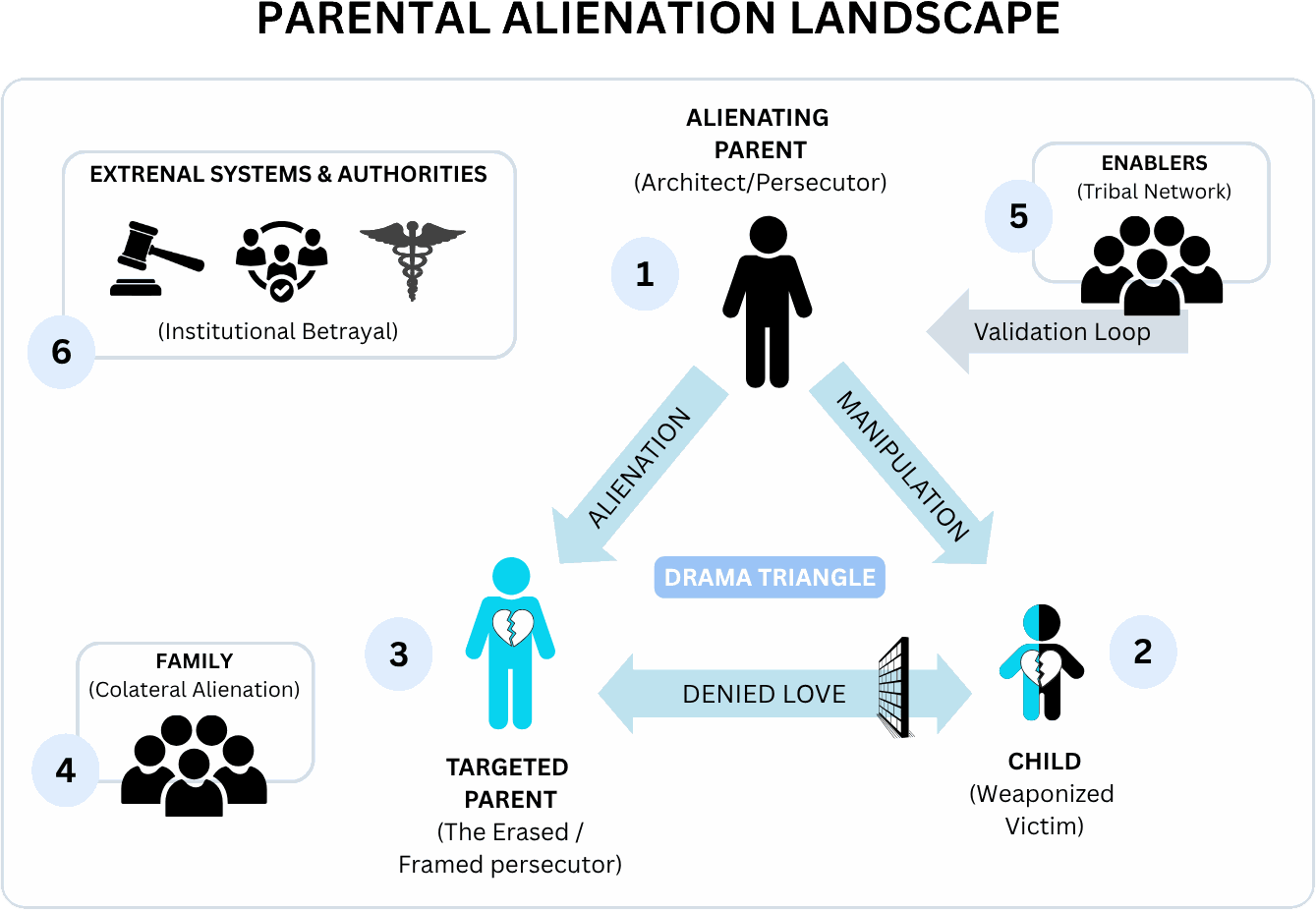
The six roles in the alienation system
Each party in this system has a specific profile, specific behaviours, and a specific psychological framework driving them. The chapters that follow on this site explore each in depth — but here is the overview of the full cast.
The Alienating Parent
The Architect / The Gatekeeper
The alienator is the engine of the dysfunction. While they often present themselves to the world as the devoted, self-sacrificing "Super Parent," research suggests a more complex psychological profile.
Cluster B personality traits
Research by Dr Amy Baker and Dr William Bernet indicates a high prevalence of narcissistic or borderline personality traits. These individuals often lack a stable sense of self and rely on the child to regulate their own emotions.
Splitting
The world is black and white. You are either "all good" (them) or "all bad" (you). They cannot integrate the idea that a "good" person can make a mistake, so they project all negativity onto the targeted parent.
Enmeshment
They do not view the child as a separate individual but as an extension of themselves. The child's love for the other parent is experienced as a personal betrayal.
Signature behaviours: gatekeeping access and information, creating the "Golden Parent" narrative, and projecting their own abusive behaviours onto you.
Read the full profile →The Child
The Weaponised Victim / The Proxy
The child is the primary victim, yet they often appear as the aggressor. This paradox is what confuses judges, therapists, and even the targeted parents themselves.
The "Independent Thinker" phenomenon
The child will claim "this is my decision" — often using adult language and legal terminology that is a primary clinical indicator of scripting by the alienating parent.
Lack of ambivalence
In healthy relationships, children have mixed feelings about their parents. Alienated children express pure hatred with no guilt. This total lack of ambivalence is clinically unique to alienation.
Identification with the aggressor
Originally identified by Anna Freud, this defence mechanism occurs when a victim aligns with their abuser to manage fear. It is safer to be the lion's tail than the lion's prey.
The child's rejection is a survival strategy, not a free choice — a domestic form of Stockholm Syndrome.
Read the full profile →The Targeted Parent
The Erased / The Framed Persecutor
The targeted parent is the object of the hate campaign. They are placed in an impossible double bind by the system itself.
Disenfranchised grief
Mourning the loss of a child who is still alive. Because the child is not dead, society does not offer the rituals of support that come with bereavement, leading to profound isolation.
The double bind
Fight for contact and you are labelled "aggressive." Step back to de-escalate and you are accused of "abandonment." The system traps you either way.
Reactive defence
Under constant attack, targeted parents may snap — sending an angry text or crying in public. The system then uses these reactions as proof of instability, ignoring the abuse that caused them.
The supporting cast
The Drama Triangle sits at the centre, but three additional parties sustain and reinforce the alienation from the outside.
The Extended Family
Collateral Damage / The Silent Victims
Grandparents, aunts, uncles, and cousins on the targeted parent's side are erased from the child's life simply by association. In the alienator's black-and-white worldview, anyone connected to you is "contaminated." The trauma is intergenerational — grandparents watch their adult child suffer while simultaneously losing their own connection to their grandchildren.
Read more →The Enablers
The Tribal Network / Flying Monkeys
Alienation rarely happens in a vacuum. The alienator surrounds themselves with a network of supporters — new partners, friends, or their own parents — who reinforce the narrative of victimhood. They provide the external validation the alienator craves and often truly believe the false narrative because they have been fed a steady diet of lies. They form the Validation Loop visible in the landscape model above.
The Professional System
The Unwitting Accomplice / Institutional Betrayal
Perhaps the most tragic party. Courts, therapists, and social services — intended to protect the child — are frequently weaponised to seal the alienation. Courts prefer stability over truth. Untrained therapists validate the child's coached "feelings," solidifying the delusion rather than challenging it. Psychologist Jennifer Freyd coined the term institutional betrayal to describe the trauma inflicted when a system fails to protect the person dependent on it.
Read more →Family Systems Theory: the framework
The structure of this model draws from Family Systems Theory, originally developed by psychiatrist Dr Murray Bowen. The core premise: a family is an emotional unit — its members cannot be understood in isolation because they are inextricably connected.
In this framework, the child is often the "Identified Patient" — the person exhibiting the visible symptoms (rejection, rage) — but the dysfunction lies in the system itself. You cannot "fix" the child without addressing the machinery that sustains their behaviour.
"As long as we view this tragedy through the lens of a 'bad breakup,' we remain blind to the structural forces at work. Understanding the cast of characters is the first step to dismantling the script."
Families naturally seek homeostasis — balance — even if that balance is dysfunctional. Currently, your family system has stabilised around your exclusion. Understanding your position on this map is the first step to disrupting it.
Where to go from here
Now that you can see the full system, the next step is to understand each role in depth — starting with the person at the centre of the dysfunction.