
There is a temptation in this journey to fast-forward past the pain — to look immediately for the "fix," the tactic, or the legal argument that will turn the tide. But you cannot navigate a terrain you do not understand, and you cannot heal a wound you are forced to hide.
This model is an original framework introduced in Love Over Exile, synthesising decades of clinical research from Gardner, Baker, Childress, Warshak, Bernet, and van der Kolk into a single, visual map of what you are going through.
It has two dimensions. The first describes what is lost. The second describes the crushing conditions under which that loss occurs. Together, they explain why parental alienation so often leads to collapse rather than recovery — and why standard advice about "moving on" completely misses the point.
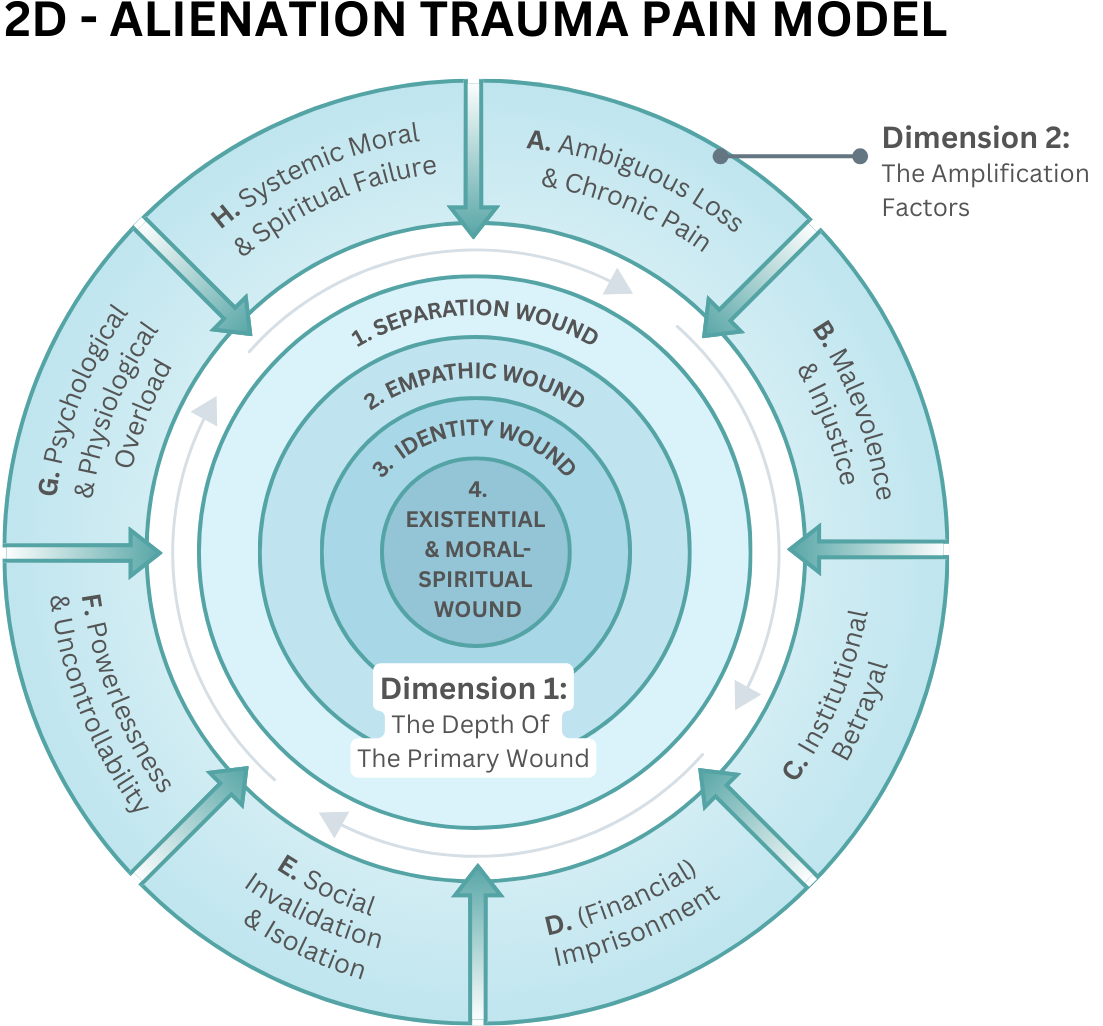
Dimension One
The Four Core Wounds
The invisible depths of the primary wound
These are not linear stages to be completed or transcended. They are deepening layers of a single, complex injury. They often coexist, overlap, and reinforce one another, shifting in intensity from day to day.
The Separation Wound
The agony of absence
The most visible layer. This is the silence of the empty room and the agony of Ambiguous Loss — the eerie, suspended grief of mourning a child who is physically absent but psychologically present, and the loss of the future you were building together.
Read more →The Empathic Wound
The torture of the helpless witness
This cuts deeper than your own loneliness. It is the biological distress of knowing your child is being harmed or manipulated while being stripped of the power to protect them. Every parental instinct is screaming — and every exit is blocked.
Read more →The Identity Wound
The collapse of self
Because parenthood is foundational to who you are, its theft triggers a crisis of meaning. When your role is stripped away, you are left with the devastating question: Who am I if I cannot be a parent?
Read more →The Existential & Moral Wound
The rupture of trust in reality
The deepest cut — a form of Moral Injury. It arises when injustice is rewarded and integrity is punished, breaking your compass for what is right, fair, and true in the world. The rules you built your life on no longer apply.
Read more →"I could endure missing my child. What I could not endure was knowing she was being told I didn't care — and not being allowed to prove otherwise."
Dimension Two
The 8 Compounding Factors
Why the pain becomes unbearable
If Dimension One describes what is lost, Dimension Two describes the crushing conditions under which that loss occurs. These factors do not create the primary wound, but they dramatically intensify it — explaining why parental alienation often leads to collapse rather than recovery.
Crucially, these forces rarely occur in isolation. Most targeted parents are bombarded by multiple factors simultaneously. This layering creates a Multiplier Effect. The pain is not simply additive; it is exponential.
Ambiguous Loss & Chronic Pain
Because the child is alive but unreachable, there is no closure. The grief "freezes," preventing the natural healing process from ever beginning. You are mourning someone who is not dead.
Read more →Malevolence & Injustice
The injury is experienced as intentional, "man-made" harm. Trauma rooted in malevolence carries a heavier psychological burden than accidental loss because it is a deliberate violation of your rights.
Read more →Institutional Betrayal
When the legal and therapeutic systems meant to protect you instead align with the abuser, it causes a specific psychological destabilisation that forces you to question reality itself.
Read more →Financial Imprisonment
The strategic depletion of resources. You are subjected to forced scarcity and unrealistic financial demands, often compelled to fund the very war being waged against you. Survival becomes a daily calculation.
Read more →Social Invalidation
Because society lacks a framework for this tragedy, your suffering is often minimised or dismissed. This Disenfranchised Grief forces you to carry the weight in shame and isolation.
Read more →Powerlessness
Repeated efforts to protect your child fail, leading to Learned Helplessness — a state where the loss of agency erodes the will to act. You stop trying because trying has only ever made things worse.
Read more →Physiological Overload
Years of unresolved stress result in Allostatic Load. Your nervous system, stuck in a state of chronic threat, eventually shuts down, making emotional regulation biologically impossible.
Read more →Systemic Moral Injury
The cumulative failure of meaning-making systems. When faith, justice, and morality all fail to provide an answer, the injury extends into profound existential isolation — becoming a "Cosmic Orphan."
Read more →The Multiplier Effect
Crucially, these two dimensions do not operate independently. The compounding factors in Dimension Two act as amplifiers of the core wounds in Dimension One. When financial ruin, institutional betrayal, and social isolation all hit at the same time as the deepest layers of grief, the pain is not simply additive — it is exponential.
This is why standard advice about "staying strong" or "moving on" completely misses the point. You are not dealing with a single loss. You are dealing with a multi-layered wound being intensified by forces that most people cannot even see.
How to use this model
The model above is not an academic exercise. It is a practical tool — a weather report for your grief. By mapping where your pain is concentrated right now, you move from formless overwhelm to something you can see, name, and begin to address piece by piece.
The Personal Pain Inventory
Rate each of the 12 factors below on a scale of 0 to 3. There is no "passing" score. This is a snapshot — a way to make the invisible visible and to track how your experience shifts over time.
| Dimension One — The Four Core Wounds | ||
|---|---|---|
| # | Factor | Your Score 0 – 3 |
| 1 | The Separation Wound The agony of absence — missing your child, ambiguous loss, frozen grief | |
| 2 | The Empathic Wound The torture of knowing your child is being harmed while you are powerless to protect them | |
| 3 | The Identity Wound The collapse of self — "Who am I if I cannot be a parent?" | |
| 4 | The Existential & Moral Wound The rupture of trust in justice, fairness, and meaning itself | |
| Dimension Two — The 8 Amplification Factors | ||
| # | Factor | Your Score 0 – 3 |
| A | Ambiguous Loss & Chronic Pain No closure — grief is frozen because your child is alive but unreachable | |
| B | Malevolence & Injustice The harm is intentional and deliberate — a "man-made" violation | |
| C | Institutional Betrayal Courts, therapists, and systems meant to protect you align with the abuser | |
| D | Financial Imprisonment Strategic depletion of resources — forced to fund the war against you | |
| E | Social Invalidation Your suffering is minimised or dismissed — disenfranchised grief carried in silence | |
| F | Powerlessness Repeated failures erode the will to act — learned helplessness sets in | |
| G | Physiological Overload Chronic stress has overwhelmed your nervous system — allostatic load | |
| H | Systemic Moral Injury Faith, justice, and morality have all failed — existential isolation | |
Reading your results
Look at your scores on both axes. The vertical depth (Dimension One) tells you how deeply the wound has penetrated your core self — from surface-level separation pain down to existential rupture. The horizontal weight (Dimension Two) tells you how wide the burden has spread — how many amplification factors are active in your life right now.
Most targeted parents sit in the bottom-right corner of this map: deep wounds amplified by multiple compounding factors, all hitting simultaneously. If that is where you are, this is not a failure of character. It is the predictable outcome of an impossible situation.
Return to this inventory periodically. As you work through the survival strategies in this guide, some factors will soften. Others will prove more stubborn. The point is not to reach zero — it is to see clearly, to name it to tame it, and to direct your limited energy to where it matters most.
"You cannot fight what you cannot see. Name it. Map it. Then — piece by piece — take it apart."
Why this looks like C-PTSD
A common misunderstanding is that alienation is "just a custody issue" or a messy divorce. But modern research has reframed it as a form of Family Violence and Coercive Control.
Because the threat is prolonged, inescapable, and interpersonal, the symptoms often mirror Complex Post-Traumatic Stress Disorder (C-PTSD). In The Body Keeps the Score, Dr. Bessel van der Kolk explains that trauma is defined by powerlessness and the inability to escape. Targeted parents experience both.
Intrusive Thoughts
Looping "case replay," obsessively reviewing old emails, mentally rehearsing arguments that will never happen.
Emotional Flashbacks
Sudden surges of panic or rage disproportionate to the moment — triggered by a song, a date, a child's laugh in a supermarket.
A "Short Fuse"
The inability to self-regulate emotions — which the alienator then uses as "proof" of your instability.
Crushing Depression
Not sadness — a systemic collapse of hope. When you are fighting a war you cannot win, the mind eventually signals: Stop. It's no use.
These are not character flaws. You are reacting to an abnormal situation with a normal survival response. Research by Dr. Amy Baker has consistently shown that targeted parents exhibit significantly elevated levels of depression, anxiety, and trauma symptoms compared to the general population.
The unspoken reality: suicide risk
We must speak openly about the darkest corner of this experience. Research by Dr. Jennifer Harman has revealed a stark reality: targeted parents are at a significantly elevated risk for suicide. In some studies, up to 23% of targeted parents reported having attempted suicide or experienced severe suicidal ideation.
If this is your current experience, please reach out now.
Samaritans: 116 123 (24/7, free from any phone)
Crisis Text Line: Text "SHOUT" to 85258
NHS Urgent Help: 111 (option 2 for mental health)
Immediate danger: Call 999
There is no shame in this. Parental alienation is a form of psychological violence, and the trauma it causes is real and measurable. You deserve help.
Where to go from here
Now that you can see the full landscape of what you are facing, the next step is building the structure to survive it. Understanding the wound is essential — but you also need practical tools.