
Stopping the over-analysis
Court rulings. The alienator's lies. Your child's current hostility. The legal system's glacial pace. Your former partner's behaviour. These are the things that keep you awake at three in the morning, churning through scenarios, rehearsing conversations that will never happen, asking "Why?" about a past you cannot change.
This is cognitive exhaustion. It feels like work — it feels productive, even necessary — but it produces nothing except more anxiety. You end each day more depleted than you started, and nothing in your actual situation has changed.
A core principle in resilience is understanding where your energy goes and learning to redirect it. The Sphere of Influence is a framework for doing exactly that.
The three circles
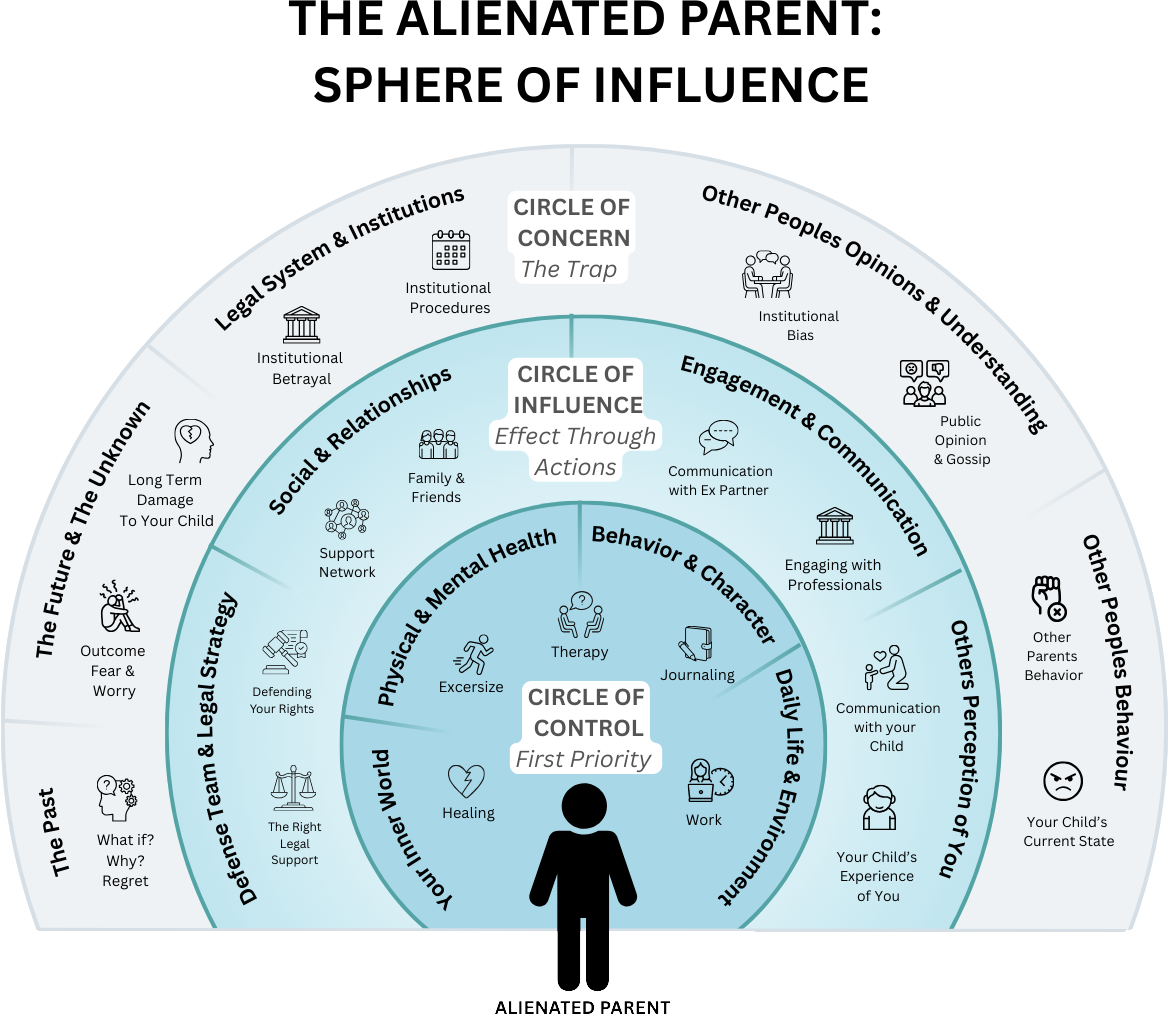
Imagine three concentric circles — each representing a different relationship between you and the things that occupy your mind.
Control
This is where you have full control. Invest your energy here first. When everything else feels unstable, this circle is your anchor — your conduct becomes your evidence, and your steadiness becomes your strength.
Focus on
- Your emotional regulation — pause before responding; breathe before reacting
- Your physical health — exercise, sleep, and nutrition are non-negotiable survival tools
- Your conduct with your child — calm, warm, consistent presence every time you see them
- Your legal compliance — follow court orders to the letter, document everything
- Your boundaries — decide what you will and will not tolerate, and hold the line
- Your record-keeping — keep a factual journal of events, dates, and communications
- Deleting the angry email — the one you wrote at 2am that feels righteous but will be used against you
Avoid
- Sending emotional messages — anything written in anger, grief, or desperation
- Neglecting your health — skipping meals, abandoning exercise, self-medicating
- Breaking court orders — even when they feel unjust, non-compliance destroys your credibility
- Badmouthing the other parent — to your child, to mutual friends, on social media
- Making decisions while dysregulated — wait 24 hours before any major action
Influence
This is where you have some effect through your actions, but not control over outcomes. Think long-term. Influence is built through credibility, patience, and consistency — not force. Operate strategically, not reactively.
Focus on
- Your child's long-term perception — every calm, loving interaction is a deposit in their memory
- Professional relationships — build credibility with your solicitor, therapist, and any court-appointed professionals
- Extended family connections — keep your side of the family informed and supportive without dragging them into conflict
- The breadcrumb trail — cards, messages, and small gestures that prove you never stopped trying
- Your narrative over time — let your consistent behaviour speak louder than any accusation
- Educating your support team — help your solicitor and therapist understand alienation dynamics
Avoid
- Forcing breakthroughs — you cannot make your child see the truth on your timeline
- Overwhelming professionals — sending 20-page emails to your solicitor at midnight
- Recruiting allies against your ex — triangulation damages your credibility
- Expecting instant results — influence is measured in months and years, not days
- Over-explaining to your child — they are not ready to hear the full story yet
Concern
These are realities that deeply affect you but are not within your power to change directly. Practise conscious acceptance — not agreement, but the disciplined refusal to waste energy fighting what you cannot control. Release this circle to free strength for where you still have agency.
Accept (for now)
- The other parent's behaviour — you cannot stop them lying, manipulating, or badmouthing you
- Court timelines — the legal system moves at its own pace regardless of your urgency
- Your child's current feelings — their hostility is a symptom of the programme, not a verdict on you
- Institutional failures — social workers, teachers, and judges who do not yet understand alienation
- Other people's opinions — mutual friends, in-laws, and social media commentators who have chosen a side
- The past — what happened in your relationship, who said what, what you should have done differently
Stop doing
- Monitoring the alienator's social media — it produces rage, not evidence
- Rehearsing court arguments at 3am — that is your solicitor's job, not yours
- Trying to control what your child is told — you cannot police the other household
- Asking "Why?" — about the past, the alienator's motives, the system's failures
- Waiting for an apology — from your ex, the court, or anyone else before you start living again
The trap: spiralling into the Circle of Concern
"You spend hours obsessing over legal strategies, imagining conversations that haven't happened, or asking 'Why?' about the past. This is cognitive exhaustion. It feels like work, but it produces nothing."
The trap is the mind's natural tendency to spiral outward — into the Circle of Concern — where you have the least power. You lie awake constructing perfect arguments for the next court hearing. You replay conversations with your child, rehearsing what you should have said. You research the alienating parent's social media posts, looking for evidence that will never be admissible and that only makes you feel worse.
All six of the most common traps that alienated parents fall into share this root: they involve spending your energy on things you cannot control. The other parent's behaviour. The court's timeline. Your child's current feelings. Social media's opinion of you. None of these are within your power to change directly.
When you catch yourself obsessing about something in the outer circle — and you will, regularly — gently redirect your attention inward. Ask yourself one question: "What can I actually do right now, in this moment, that is within my control?" That question, asked honestly and repeatedly, is one of the most powerful survival tools you have.
Reclaiming your power
Reclaiming your power means gently redirecting your focus — again and again — back to your Sphere of Influence. This is not denial. It is not giving up. It is the disciplined stewardship of your limited energy.
You need to be able to tell yourself: "I am safe today. I am okay this week." You do not need perfect answers about the future. You just need "good enough" answers to soothe your mind today.
Let the professionals carry the strategy
Your lawyer, mediator, and therapist exist for a reason. Let them carry the weight of legal strategy, court preparation, and psychological analysis. Your job is not to become an expert in family law or forensic psychology. Your job is to steward your own sanity — because without that, nothing else works.
This does not mean being passive. It means being strategic about where your energy goes. You stay informed. You make decisions. You show up. But you do not try to do everyone's job, and you do not spend your evenings doing work that belongs in your solicitor's office.
The daily practice
The Sphere of Influence is not something you understand once and then apply perfectly forever. It is a daily practice — a discipline of attention. Every day, sometimes every hour, you will find your mind drifting back to the outer circle. That is normal. The skill is not in preventing the drift; it is in noticing it and gently bringing yourself back.
- Morning check-in: Ask yourself — what is in my control today? What can I actually influence? What must I accept for now?
- The redirect: When you catch yourself spiralling ("What if the court rules against me?"), pause and ask: "What can I do about that right now?" If the answer is nothing, redirect to something in your control.
- The evening release: Before sleep, consciously hand over the things in the outer circle. "I have done what I can today. The rest is not mine to carry tonight."
Why the traps exist
Nearly every mistake alienated parents make — revenge, social media outbursts, over-spending on legal, badmouthing, overcompensation, giving up — comes from the same place: pouring energy into the Circle of Concern instead of the Circle of Control.
When you understand the Sphere of Influence, the traps become easier to recognise before you fall into them. You can see the revenge impulse for what it is — energy directed at the outer circle. You can see the social media temptation as an attempt to control something uncontrollable. You can see over-litigation as throwing money at the Circle of Concern.
The framework does not make the emotions go away. You will still feel the rage, the grief, the desperation. But it gives you a filter — a split-second of clarity between the feeling and the action — that allows you to choose where your energy goes.
"Every drop of energy you redirect from the outer circle to the inner one is an investment in your future — and your child's."
Where to go from here
The Sphere of Influence works alongside the other survival tools — the Cognitive Diet, Strategic Journaling, and understanding the traps that alienation sets for you.