
Definition · The alienating parent and the machine of erasure
An alienating parent is the parent driving a child's unjustified rejection of the other parent through psychologically manipulative behaviours — what the UK Family Justice Council December 2024 guidance calls "alienating behaviour" and what Bernet and Greenhill (2022) call Factor 4 of the Five-Factor Model. The behaviours fall into Baker's 17 documented strategies across five canonical categories — poisonous messaging, limiting contact, erasing and replacing, encouraging betrayal, and undermining authority — and into a four-layer escalation system this site calls the Machine of Erasure: core motive, manipulation methods, escalation shield (enablers + weaponised institutions), and total erasure (false allegations, the nuclear option). The framework is observable behaviours, not a diagnostic label.
Working definition adapted from Baker (2007) Adult Children of Parental Alienation Syndrome, Bernet & Greenhill (2022) Five-Factor Model, and the FJC December 2024 UK guidance on alienating behaviour.
By Malcolm Smith · Last updated April 2026 · Based on peer-reviewed research
What is an alienating parent?
An alienating parent is a parent who systematically damages their child's relationship with the other parent — through manipulation, badmouthing, gatekeeping, loyalty traps, and psychological conditioning. The alienating parent turns the child against the targeted parent, not because that parent has done anything wrong, but to maintain control, punish the other parent, or meet their own emotional needs.
The research on alienating parents is clear about one thing: there is no single profile. Some are driven by narcissistic personality traits. Some are consumed by unresolved anger. Some genuinely believe they are protecting the child. And some — this is the part that is hardest to accept — are barely aware of what they are doing.
An estimated 22 million parents in the United States are targeted by alienating behaviours (Harman, Leder-Elder & Biringen, 2019). In the UK, 39-59% of separated parents report experiencing them. TheHarman, Kruk & Hines (2018) review in Psychological Bulletinclassified alienating behaviours as a form offamily violence — child psychological abuse and intimate partner violence, producing outcomes comparable to other recognised forms of abuse.
What are the signs of an alienating parent?
Dr Amy Baker's research identified17 specific strategies that alienating parents use. These are the most common warning signs:
- Badmouthing — consistently disparaging the other parent to the child.
- Limiting contact — blocking, cancelling, or "forgetting" scheduled time with the other parent.
- Interfering with communication — intercepting phone calls, messages, or gifts.
- Confiding adult information — sharing details about the separation, finances, or legal proceedings with the child.
- Forcing loyalty choices — making the child feel guilty for enjoying time with the other parent.
- Withdrawing love conditionally — warmth depends on the child rejecting the other parent.
- Using the child as a spy — asking the child to report back on the other parent's life.
- Introducing a replacement parent — encouraging the child to call a new partner "mum" or "dad."
- Creating fear — telling the child the other parent is dangerous or doesn't love them.
- Making false allegations — the most extreme escalation, designed to trigger institutional intervention.
For the full 17 strategies with detailed descriptions, seeBaker's 17 Strategies of Alienation. For the behavioural signs in the child that result from these tactics, seeSigns of Parental Alienation.
What is the Machine of Erasure in parental alienation?
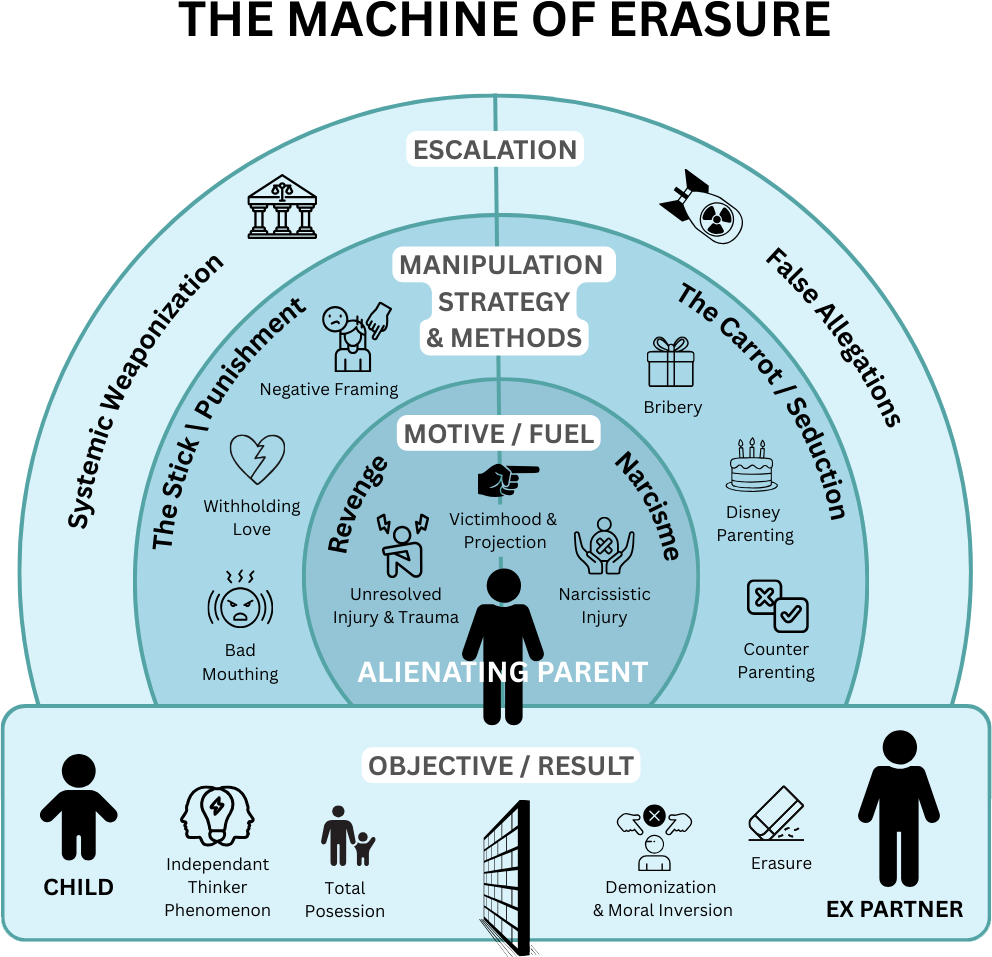
Alienation is not a single behaviour. It is a system — a machine with moving parts, each reinforcing the others. The Machine of Erasure model maps this system from the inside out: from the psychological motives that fuel it, through the manipulation methods that execute it, to the escalation patterns that protect it from intervention.
Understanding this model gives you something no amount of emotional processing can: a structural map of what you are dealing with. When you can see the machine, you can begin to describe it — and when you can describe it, professionals can begin to act on it.
Figure 1 — The Machine of Erasure, four layers. Each layer escalates when the previous one fails; most cases stop at layer 2 or 3.
Layer 1 (core motive): revenge after separation, narcissistic injury, hostile attachment — using the child as ally and trophy. The motive is rarely conscious in its full form; it is felt as righteous grievance.
Layer 2 (manipulation methods): Baker's 17 strategies across five canonical categories — poisonous messaging, limiting contact, erasing and replacing, encouraging betrayal, undermining authority. Observable behaviours, derived from forty interviews with adults alienated as children (Baker 2007).
Layer 3 (escalation shield): when personal manipulation fails, the alienating parent recruits enablers — new partner, friends, family — and weaponises institutions (family courts, schools, social services, therapists).
Layer 4 (total erasure): the nuclear option — false allegations, often of abuse. The most consequential layer, and the one the FJC December 2024 guidance was partly drafted to correct.
Diagram by Love Over Exile, after Baker (2007), Bernet & Greenhill (2022), and FJC December 2024.
The Core — Motive and Fuel
At the centre of every alienation campaign is a motive. The research identifies three primary drivers: revenge — turning the child into a weapon to punish you for the relationship ending;narcissistic injury — destroying the mirror that no longer flatters; andhostile attachment — maintaining a connection through conflict because hate feels safer than loss. These motives are the fuel. Without them, the machine does not run.
The Inner Gears — Manipulation Methods
The motives drive two complementary strategies. The Stick uses punishment and reality distortion: badmouthing, gaslighting, selective attention, context stripping, and the no-correct-response trap. The Carrot uses seduction: bribery, counter-parenting, the "Disney parent" lifestyle, and the golden handcuffs that make leaving the alienator's world feel impossible. Baker's 17 documented strategies map across both.
The Outer Shield — Escalation
When personal manipulation is not enough, the alienator escalates — outsourcing the abuse to systems and networks. The enabler network provides validation and a Greek Chorus that makes the lie feel like truth. Institutional weaponisationturns the legal system, therapy, and child protective services into unwitting participants. And when all else fails, the nuclear option — false allegations — triggers a systemic freeze that does the alienator's work for them.
The Result — Erasure
The machine's objective is total erasure. The child becomes the "independent thinker" — rejecting you with conviction, parroting the alienator's narrative as their own, displaying none of the ambivalence that characterises genuine estrangement. The targeted parent is demonised. The alienator achieves total possession. And the child — the real victim — loses a parent they once loved, without understanding why.
Exploring the machine
Each layer of the Machine of Erasure is explored in depth across nine pages. Follow the model from the inside out — or start with whatever resonates most with your situation.
The Core — Why They Do It
Narcissistic Parental Alienation
What drives them
Narcissism, enmeshment, revenge, fear of losing control — and the alienator's own childhood wounds. The three motives that fuel every campaign, and the intergenerational patterns that explain how someone can harm their own child.
Read more →Conscious vs Unconscious Alienation
The spectrum of intent
Not all alienation is deliberate. Darnell's four types — from naïve to obsessed — and why the distinction changes everything about intervention strategy, legal approach, and how you describe it to professionals.
Read more →The Inner Gears — How They Do It
Baker's 17 Strategies
The documented tactics
Dr Amy Baker identified 17 specific strategies in four mechanisms: the Poisoned Narrative, the Iron Curtain, the Loyalty Trap, and the Erasure. Recognising the pattern in your situation is evidence.
Read more →Gaslighting and Reality Distortion
The stick — punishment and manipulation
Warshak's continuum from badmouthing to brainwashing. The "fast flip," language as psychological surgery, selective attention, context stripping, and the no-correct-response trap.
Read more →The Golden Handcuffs
The carrot — seduction and bribery
Not all alienation operates through punishment. The "Disney parent" trap, material bribery, the electronic leash, counter-parenting, and why it is not love — it is grooming.
Read more →The Outer Shield — How They Escalate
The Enablers
The tribal network
Alienation is rarely a solo act. Flying monkeys, the whisper campaign, the "Greek Chorus Effect," bystander complicity, and how the alienator recruits an entire community.
Read more →Weaponising Institutions
Outsourcing the abuse
How the legal system, therapy, and child protective services are turned into unwitting participants. When the institutions designed to protect your child become the instruments of erasure.
Read more →The Nuclear Option
False allegations as the ultimate weapon
When ordinary weapons stop working. Why false allegations are so devastatingly effective, the three paths to a false accusation, the science of false memory, what the data shows, and surviving the silver bullet.
Read more →Surviving False Allegations
What to do when you are falsely accused
The practical companion to The Nuclear Option — how to respond to a false allegation, protect yourself, work with the professionals involved, and come through it with your integrity and your case intact.
Read more →The Framework — What It Really Is
"What struck me most about the research was how ordinary it all looked from the outside. Each tactic, taken alone, could be explained away. It is the pattern — relentless, cumulative, deliberate or not — that constitutes the abuse."
What can you do about an alienating parent?
Understanding the alienating parent is essential — but understanding alone does not protect your child. Here are evidence-based steps:
- Document the pattern. Keep a factual log of alienating behaviours — dates, what was said, witnesses, screenshots. This is your evidence. See the Survival Guide for documentation frameworks.
- Learn the language.Baker's 17 strategies, Gardner's eight signs, and the Five-Factor Model give you the vocabulary that courts and therapists respond to.
- Find PA-aware professionals. A therapist or lawyer who does not understand alienation will not help — and may make things worse. See Institutions & the System for guidance.
- Use the BIFF method.Brief, Informative, Friendly, Firm — the communication framework that protects you from escalation.
- Stay connected to your child. The Breadcrumb Strategy keeps the door open even when contact is blocked.
- Protect your mental health.Health and safety comes first — you cannot help your child if you are destroyed by the process.
Frequently asked questions about alienating parents
What motivates an alienating parent?
Research identifies three primary drivers: revenge(turning the child into a weapon), narcissistic injury(destroying the mirror that no longer flatters), and hostile attachment (maintaining connection through conflict). Some alienating parents are fully aware. Others act from unresolved pain, personality disorders, or their own childhood wounds. SeeNarcissistic Parental Alienation.
Is the alienating parent always aware of what they are doing?
No. Darnell's four-type model classifies alienating parents along a spectrum: naïve (unintentional), active (aware but rationalise), obsessed (consumed, often with personality disorder traits), and enmeshed (using the child to meet emotional needs). The distinction changes everything about intervention. SeeConscious vs Unconscious Alienation.
What are the signs of an alienating parent?
Key signs include: badmouthing, blocking contact, confiding adult information, forcing loyalty choices, conditional love, using the child as a spy, introducing a replacement parent, and making false allegations. Dr Amy Baker documented17 specific strategies across four categories. See thesigns checklist above.
Can an alienating parent change?
It depends on the type. Naïve alienators can sometimes change with education and therapy. Active alienators may change when faced with clear consequences. Obsessed and enmeshed alienators rarely change voluntarily — the behaviour is driven by deep personality pathology. The key factor is whether the alienating parent has the capacity for self-reflection.
What personality disorders are linked to alienating behaviour?
Research associates alienating behaviour with narcissistic personality disorder, borderline personality disorder, and antisocial personality traits. However, not all alienating parents have a diagnosable disorder — some are driven by situational anger, fear of losing the child, or their own childhood experience. SeeNarcissistic Parental Alienation.
How do you prove alienating behaviour in court?
Documentation is essential: factual logs, saved communications, contact denial records, and school/medical records showing gatekeeping. TheBernet Five-Factor Model is the clinical framework courts use. In England and Wales, the Family Court Adviser uses theCafcass July 2025 Understanding RRR guide with its Four As assessment model — Cafcass has formally abandoned the term 'parental alienation' and findings of fact are for the court alone, not Cafcass. Expert witnesses can assess usingGardner's eight signsand Baker's 17 strategies; UK expert witnesses must be HCPC-registered psychologists.
References
- Baker, A. J. L. (2007). Adult Children of Parental Alienation Syndrome: Breaking the Ties That Bind. W. W. Norton. Publisher · In catalogue · Source for the 17 alienating strategies.
- Baker, A. J. L., & Darnall, D. (2006). Behaviors and strategies employed in parental alienation: A survey of parental experiences. Journal of Divorce & Remarriage, 45(1–2), 97–124. DOI: 10.1300/J087v45n01_06
- Darnall, D. (2008). Divorce Casualties: Understanding Parental Alienation (2nd ed.). Taylor Trade Publishing. Publisher · Source for Darnall's four alienator types (naïve, active, obsessed, enmeshed).
- Warshak, R. A. (2010). Divorce Poison: How to Protect Your Family from Bad-mouthing and Brainwashing (New and Updated Edition). William Morrow / HarperCollins. warshak.com · Source for the badmouthing → bashing → brainwashing continuum.
- Childress, C. A. (2015). An Attachment-Based Model of Parental Alienation: Foundations. Oaksong Press. drcraigchildressblog.com
- Harman, J. J., Kruk, E., & Hines, D. A. (2018). Parental alienating behaviors: An unacknowledged form of family violence. Psychological Bulletin, 144(12), 1275–1299. DOI: 10.1037/bul0000175 · Summary · Classifies PA as an unacknowledged form of family violence.
- Clawar, S. S., & Rivlin, B. V. (2013). Children Held Hostage: Identifying Brainwashed Children, Presenting a Case, and Crafting Solutions (2nd ed.). American Bar Association. Publisher · ABA study of over 1,000 custody cases underpinning several of the escalation patterns described.
See the full curated bibliography on our research page.